
 English
 Français
ABM Governance

Strong governance is essential for a results-based finance mechanism. ABM governance is designed to ensure that certified adaptation benefits are credible, that decision-making is transparent and science-based, and that stakeholders have clear avenues for consultation and redress.
During the ABM pilot phase, governance has been structured to be lean but robust: an independent Executive Committee is supported by technical panels, expert rosters and a secretariat, with processes for validation, registration, verification and issuance of CABs.
Governance Principles
ABM governance is built around practical principles that protect integrity while enabling delivery:
- Transparency: public documentation, consultations and registry-based information.
- Independence: expert bodies and validation/verification arrangements that reduce conflicts of interest.
- Technical rigor: methodologies and indicators designed to be measurable, appropriate and reliable.
- Accountability: safeguards and grievance processes that allow concerns to be raised and addressed.
Governance Structure at a Glance
ABM governance includes the following key functions and bodies:
- Interim Adaptation Benefits Mechanism Executive Committee (ABM EC).
- ABM Secretariat (hosted during the pilot phase within the African Development Bank).
- ABM Methodology Panel and supporting rosters of experts.
- Validation and Verification Roster of Experts (VVRE) and activity-specific teams for validation or verification (VAST).
- The ABM Registry and online platform for publication of documents and CAB information.
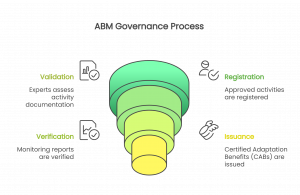
Roles and Responsibilities
Interim ABM Executive Committee (ABM EC)
- Provides strategic direction for ABM operationalization and oversees the pilot phase rules.
- Approves ABM methodologies and tools.
- Decides on registration of ABM activities and issuance of CABs into the ABM Registry.
ABM Secretariat
- Manages submissions and process steps, including completeness checks and communications.
- Supports the ABM EC and technical bodies, and publishes relevant documents on the ABM platform.
- Maintains registry-related processes and coordinates stakeholder consultation periods.
ABM Methodology Panel and Technical Expertise
- Supports science-based review of methodologies, indicators and monitoring approaches.
- Provides recommendations to the ABM EC on methodological soundness and consistency.
Validation and Verification Roster of Experts (VVRE) and VAST Teams
- The VVRE is a pool of technical experts from which activity-specific teams (VAST) are formed for validation or verification.
- VAST teams assess validation of activity documentation and verification of monitoring reports, and prepare public reports.
- Experts who validate a proposed activity are not involved in verifying the same activity, supporting independence.
Integrity Systems: Safeguards, Consultations and Grievance
ABM governance includes additional layers of integrity beyond technical review:
- Stakeholder consultations: local and international stakeholders can participate at defined stages of the activity cycle.
- Host country approval: government approval helps ensure alignment with national adaptation priorities and correct recognition in reporting.
- Additionality and financial feasibility requirements: activities should not be business-as-usual and should demonstrate the finance gap that CAB payments are intended to close.
- Social and environmental safeguards: guidance and pre-assessment help identify and address potential adverse impacts.
- Grievance and redress: stakeholders can submit grievances related to ABM EC decisions or activity impacts, with processes for consultation, review and escalation.
Transparency through the ABM Registry
CABs are issued and tracked in the ABM Registry. Each CAB is linked to a unique CAB Code and a package of verified information that can be used for reporting on adaptation action, co-benefits and adaptation finance. Relevant information is made available to Parties involved and other stakeholders as applicable.
From Pilot Governance to Long-Term Governance
ABM has been developed and hosted by the African Development Bank during the pilot phase (2019-2025), with an interim governance structure. The ABM Transition Phase (2026-2030) is focused on scaling the mechanism into a multi-partner platform, supported by sustainable hosting arrangements, strengthened secretariat capacity and robust demand for CABs.
Call to Action
For governance-related questions, documentation requests or partnership discussions, contact the ABM Secretariat: abmechanism@afdb.org
FAQ
Q: Who oversees the issuance of CABs?
A: CAB issuance decisions are taken under the ABM governance framework. The ABM Executive Committee considers verification outputs and approves issuance of CABs into the ABM Registry.
Q: How is independence ensured in validation and verification?
A: ABM uses a Validation and Verification Roster of Experts and forms activity-specific teams (VAST). Experts who validate an activity are not involved in verifying the same activity.
Q: How can stakeholders raise concerns?
A: ABM has a grievance and redress mechanism for concerns related to ABM EC decisions or the impacts of ABM activities. The approach emphasizes consultation and review, with options for formal submission and escalation.
Q: Are ABM documents publicly available?
A: ABM governance processes emphasize transparency. Key documentation and reports are published through the ABM online platform and registry processes.
Q: How does governance protect environmental and social integrity?
A: ABM integrates approved methodologies, stakeholder consultations, additionality requirements, social and environmental safeguards and grievance processes to strengthen integrity and accountability.

PROJECT