
 English
 Français
Why Non-Market Approaches Matter for Climate Adaptation

Non-market approaches (NMAs) under Article 6.8 of the Paris Agreement are designed to enable international cooperation without creating tradable compliance units. This matters for adaptation because resilience outcomes are highly context-specific and are not well suited to being turned into a single, fungible commodity.
The Adaptation Benefits Mechanism (ABM) is structured as a non-market approach. It certifies adaptation benefits as CABs and links them to transparent, verified information that can be exchanged for finance without creating incentives for speculation.
Adaptation outcomes are local and non-fungible
Unlike emissions reductions (measured in tonnes of CO2e), adaptation results vary by location, climate risk, community needs and development context. Two projects may both improve resilience, but their benefits are not interchangeable.
- Adaptation benefits are tied to specific people, ecosystems and hazards.
- The value of resilience is often expressed through multiple indicators and outcomes, not a single universal unit.
- Local priorities and national adaptation plans shape what ‘success’ looks like.
ABM’s non-market design keeps the focus on finance and outcomes
ABM uses CABs as a non-market instrument. CABs are issued in the ABM Registry with unique CAB Codes and are designed to be used only once. This helps keep the mechanism focused on delivering verified outcomes and closing finance gaps, rather than enabling arbitrage and speculative trading.
- CABs provide reporting-ready evidence and a transparent link between finance and delivered results.
- CAB purchasing is based on willing buyer-willing seller agreements that reflect the project’s incremental costs and finance needs.
- Because CABs are not designed as a tradable compliance commodity, the mechanism avoids adding a speculative layer between finance and real-world adaptation.
Environmental integrity and host-country ownership of co-benefits
Many adaptation activities also generate mitigation co-benefits. Under ABM, these co-benefits are not transferred internationally. They remain with the host country, supporting national ownership and integrity in reporting.
- CABs are for adaptation benefits, not for transferring mitigation outcomes.
- Mitigation co-benefits can be reported, but they remain in the host country and are not exported as tradable units.
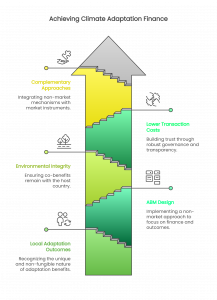
Lower transaction costs and higher trust
ABM builds on proven elements of robust climate governance (methodologies, stakeholder consultation, independent checks and registry transparency) while avoiding complexity driven by tradable compliance instruments.
- Approved methodologies define baselines, indicators and monitoring approaches for adaptation benefits.
- Independent validation and verification provide confidence in what is claimed and what is delivered.
- Public documentation and consultation periods strengthen transparency and accountability.
Complementary to market mechanisms, not a replacement
Non-market approaches and market mechanisms can be complementary. ABM focuses on mobilizing finance for adaptation and resilience, while carbon markets and other instruments can address mitigation or broader climate finance objectives.
- ABM can be combined with other financial instruments such as climate and sustainable bonds and guarantees.
- ABM can help local and national actors engage the private sector in adaptation planning and implementation.
FAQ
Q: What makes ABM a non-market approach?
A: The primary ABM instrument (CABs) is not designed as a tradable compliance commodity. CABs are uniquely coded, issued in the ABM Registry and used once to support transparency and reporting rather than market speculation.
Q: Can CABs be used to offset emissions?
A: No. CABs certify adaptation benefits. Any mitigation co-benefits associated with an ABM activity are not transferred internationally and remain with the host country.
Q: How can CABs be priced without a market?
A: CAB pricing is agreed through purchase or off-take agreements and typically reflects the incremental costs and finance gap needed to deliver verified adaptation benefits, rather than supply-demand trading dynamics.
Q: Does ‘non-market’ mean the private sector cannot participate?
A: No. Private sector actors can participate as purchasers, investors, lenders or activity participants. The non-market design simply means CABs are not structured as tradable compliance units.
Q: Is ABM linked to the Paris Agreement?
A: Yes. ABM is recognized as a non-market approach under Article 6.8 of the Paris Agreement and is designed to support transparency and reporting needs related to adaptation and finance.

PROJECT