
 English
 Français
Why Pay for Certified Adaptation Benefits (CABs)

Climate adaptation is urgent and often underfunded. Many high-impact adaptation activities face a finance gap because the costs of delivering resilience outcomes are not fully covered by existing revenue streams or budgets.
CABs create a results-based way to close that gap. Paying for CABs means paying for verified adaptation benefits and for the transparent evidence that shows what was delivered, where and how.
Operational Modalities
The ABM is based on two complementary approaches:
- Ex-post: generation of Certified Adaptation Benefits (CABs) from projects that have already been implemented and funded through grants. Revenues from the sale of these CABs help replenish the initial funding to replicate or scale up projects.
- Ex-ante: mobilization of private capital for future adaptation projects through forward purchase commitments of CABs (Adaptation Benefit Supply Agreement or ABSA) by creditworthy buyers. These commitments make projects bankable, enabling access to debt and equity financing.
Projects follow a rigorous cycle: methodology approved by the ABM Executive Committee, independent validation and verification, and official certification of benefits. CABs are non-transferable and non-speculative, ensuring that every dollar spent directly supports climate action on the ground.
Convert verified resilience results into finance
ABM is designed to facilitate payments upon delivery of certified adaptation benefits. This helps adaptation activities access an additional revenue stream that can make the difference between a concept and an implementable, scalable project.
- CAB payments can be structured around delivery of verified results, supporting results-based adaptation finance.
- CAB payments are designed to overcome financial barriers and cover the incremental costs needed to deliver adaptation benefits beyond business-as-usual.
Make projects bankable and leverage private capital
CAB purchase and off-take agreements can improve a project’s financial profile by creating predictable cash flows tied to verified outcomes. This can help unlock debt and equity for adaptation activities.
- Off-take agreements for CABs can be used as collateral for commercial loans, in a way similar to how emissions reduction purchase agreements were used for mitigation activities.
- By reducing revenue uncertainty, CAB-linked agreements can de-risk investment in contexts where adaptation needs are high and capital is scarce.
Strengthen transparency, credibility and reporting
CABs are linked to a package of verified information on progress toward resilience, co-benefits and adaptation finance. This provides robust evidence for transparency and reporting, including but not limited to:
- Reporting under the Paris Agreement transparency framework.
- Contribution to the Sustainable Development Goals and other development results frameworks.
- Corporate ESG and CSR disclosure and communication needs.
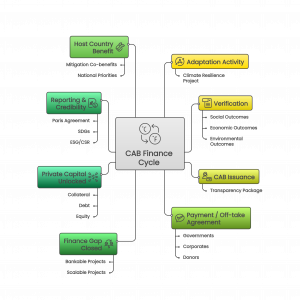
Support host-country priorities and avoid unintended outcomes
ABM activities are designed to be aligned with host-country priorities and to be implemented with transparency and safeguards.
- Host country approval supports alignment with national adaptation priorities and recognition in reporting.
- Stakeholder consultations, social and environmental safeguards and a grievance and redress mechanism support accountability and responsible implementation.
A clear signal: adaptation finance without offsets
CABs are an adaptation-focused, non-market instrument. They are not designed as compliance units or carbon offsets.
- CABs support adaptation finance and verified resilience outcomes.
- Any mitigation co-benefits associated with an ABM activity are not transferred internationally and remain with the host country.
What paying for CABs communicates
A CAB purchase signals that you are financing measurable, verified adaptation results. It demonstrates that your organization values climate resilience, supports credible impact measurement and is willing to pay for outcomes, not promises.
Call to action
If you are interested in purchasing CABs or exploring off-take structures (including pay-on-delivery and pre-payment options), contact the ABM Secretariat: abmechanism@afdb.org
FAQ
Q: Why pay for CABs instead of making a general donation?
A: CABs link funding to verified results and provide a structured, reporting-ready information package. This can improve transparency and help demonstrate what your finance achieved.
Q: Do CAB payments go to projects or to intermediaries?
A: CAB payments are designed to close the finance gap of the underlying adaptation activity. ABM’s non-market design avoids a speculative trading layer and focuses finance on delivering verified outcomes.
Q: Can CAB purchases help mobilize private investment?
A: Yes. CAB off-take agreements can improve revenue certainty and can be used by activity participants to attract debt and equity. Commercial banks may also use CAB off-take agreements as collateral for loans.
Q: What kinds of results do CABs cover?
A: CABs cover certified adaptation benefits as defined in approved methodologies. Depending on the activity type, this can include social, economic and environmental resilience outcomes and relevant co-benefits.
Q: Are CABs suitable for ESG reporting?
A: Yes. CABs provide verified information that can support ESG, CSR and sustainability reporting, alongside reporting under the Paris Agreement and the SDGs.

PROJECT